One Dance On The Hillside
The dance hall was on the way.
I’d been on the island all day and I was worn through, mostly through mismanaging my own sleep needs admittedly but also from long days of travel. There was a community square dance that evening, and nobody I spoke with that day seemed to know much more about it than that. We almost didn’t stop. When I pictured it, I saw a rec hall: fluorescent tubes humming overhead, a folding table of store-bought cookies, a speaker crackling out a recording, and a dozen dancers whose average age was somewhere north of 80. I told myself I’d look in, maybe stay a few minutes, and probably not dance at all.
That isn’t what I found.
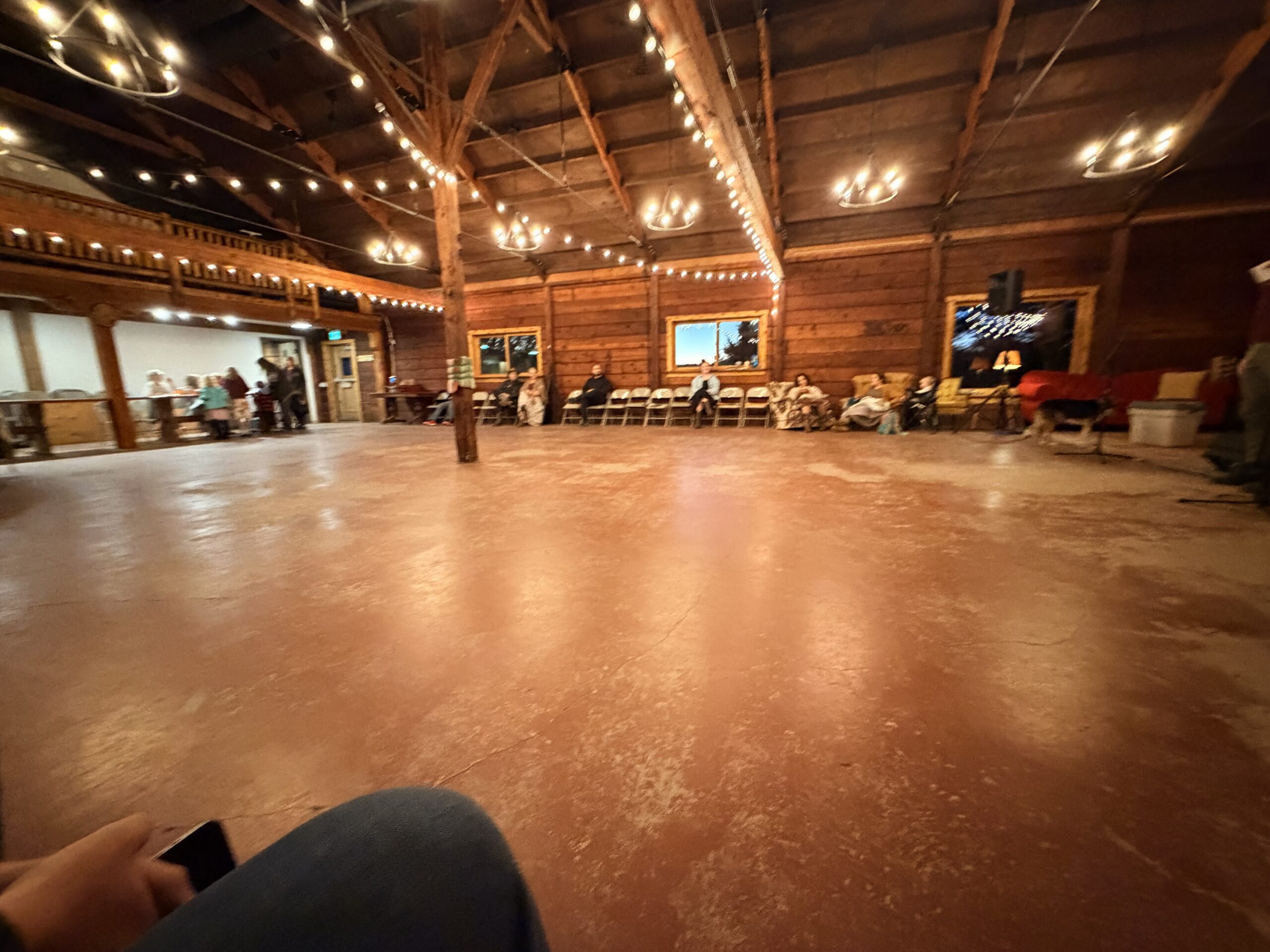
The hall was a small cabin set up on a hillside, with one large room inside and nothing much around it but dark trees. The only light on the path up to the door came from a single strand of string lights, strung from post to post and swaying in the wind, so the whole walk seemed to flicker a little. I could hear music before I reached the steps. Not a recording. A fiddle, a guitar, something low and steady keeping the beat– I think it was the bottom of a shoe.
A young girl sat at the door with a can for cash donations, serious about her post but seemed genuinely happy to be there.
On a makeshift stage at the far end, a little folk and bluegrass band was playing. I caught myself listening for a mandolin, out of an old habit I’ve had since my father’s festival days. There were maybe ten or fifteen people in the room, mostly families. The girls (young ones and grown ones both) wore patchwork dresses, and nearly every one of them had a giant bow in her hair. Someone called the steps over the music. People who weren’t dancing were clapping along or watching with the kind of attention you rarely see in a room anymore.
A mother reached out and took my right hand. Her daughter, who couldn’t have been more than eight or nine, took my left. And then the line of us moved across that wooden floor together, stepping in time, hands joined, in one long chain of strangers.
I’ve tried to describe it to a few people since and I keep reaching for the same comparison. It looked like a scene from a fantasy film, the kind where the travelers stumble into a village celebration and get pulled into the dance before they know anyone’s name.
I only did the one dance. That was all I had in me. Afterward I thanked them and walked back down the hill, and I kept turning around to watch the string lights get smaller behind me until the trees swallowed them.
The first thing I noticed, once I was back in the car, was what hadn’t been there.
There wasn’t a phone in sight. Not one person was filming, not one was checking a screen between songs, not one was holding up the dance to get a better angle. Nobody was in a hurry. As far as I could tell, nobody had an agenda past the next song. They were simply there, doing the thing in front of them, together.
And I was convicted by how complicated I’ve let my own life become. Not in some vague, Sunday-morning way, either. I felt it in the chest. I’d been handed a moment so uncluttered that it showed me, by contrast, how much clutter I carry everywhere else.
The Preacher in Ecclesiastes has a line that has been following me around since. “See, this alone I found, that God made man upright, but they have sought out many schemes” (Ecclesiastes 7:29). The older translations say many inventions. The Hebrew word, chishbonot, carries the sense of calculations, contrivances, clever devices. God made us straightforward, and we have spent the centuries since inventing ways to complicate ourselves.
I think of my calendar, my notifications, my running mental list of who needs what from me and by when. Some of that is necessary. A lot of it, I suspect, is inventions.
Jesus has a word for the kind of eye I saw in that room.
“The eye is the lamp of the body. So, if your eye is healthy, your body will be full of light” (Matthew 6:22). The Greek word translated healthy is haplous, which means single, simple, undivided. Literally, something not folded over on itself. Paul uses the same family of words when he worries that the Corinthians will be led away from “a sincere and pure devotion to Christ” (2 Corinthians 11:3), where the older translations read the simplicity that is in Christ.
An undivided eye. That’s what I watched in that hall. People looking at one thing at a time, with their attention unfolded and laid flat, and the room did seem full of light, and not only from the string lights outside.
My eye is rarely single. Even on good days I’m watching the thing in front of me with one part of my attention and three other things with the rest. I’ve gotten so used to the folding that I’d stopped noticing it, until I spent ten minutes among people who weren’t doing it.
I also noticed that nobody there was performing.
No one in that cabin was creating content. The girls in their bows weren’t posing. The band wasn’t recording an album. The families weren’t documenting a wholesome evening for anyone else to admire later.
Luke tells us that after the shepherds came and went, “Mary treasured up all these things, pondering them in her heart” (Luke 2:19). The verb means to keep close, to preserve, to hold safely. She didn’t broadcast the night her son was born. She kept it, and kept turning it over, inside.
I think something happens to a moment when we stop living it in order to save it. We’ve traded the treasuring for the recording. And I’m as guilty of it as anyone. I nearly reached for my own phone in that hall, out of pure reflex, before I saw that nobody else had and felt faintly embarrassed.
Aside from the hall itself, I don’t have a single photo of it. I’m writing this from memory, which is maybe the most fitting thing I could do.
The picture of young and old dancing together is older than square dancing.
I went looking afterward, because I wanted to know whether God’s Word had anything to say about what I’d seen, and I found more than I expected. When Jeremiah describes the restoration God promises to His scattered people, one of the images he chooses is a dance. “Then shall the young women rejoice in the dance, and the young men and the old shall be merry. I will turn their mourning into joy” (Jeremiah 31:13). Earlier in the same chapter, the virgin Israel adorns herself with tambourines and goes out “in the dance of the merrymakers” (31:4).
Zechariah paints something similar. “Old men and old women shall again sit in the streets of Jerusalem… And the streets of the city shall be full of boys and girls playing in its streets” (Zechariah 8:4-5).
Neither prophet describes the redeemed city as efficient. Neither describes it as productive. They describe grandparents sitting in the street watching children play, and young and old dancing in the same room. That’s what God chose as His picture of things being put right.
I held a mother’s hand on one side and her daughter’s on the other. I didn’t know their names. I’d been invited in without any credentials. And for the length of one song, I think I was standing inside a small piece of Jeremiah’s promise.
I was there for one dance. One. I don’t know those families. I don’t know what they argue about at dinner, or what their bills look like, or whether the girl at the door gets bored of that donation can by the second hour. Every community has its tensions, and I saw none of them. It’s very easy to romanticize a life you only visited for twenty minutes, on an island, while exhausted enough that your defenses were down.
Ecclesiastes warns about exactly this. “Say not, ‘Why were the former days better than these?’ For it is not from wisdom that you ask this” (7:10). Longing for a simpler past, or a simpler place, can become its own kind of discontent. It can make me resent the life I have instead of tending it.
So I don’t think the lesson is to move to an island and buy a patchwork dress (though I’d be lying if I said I hadn’t considered the dress). I can’t hand back my job or my responsibilities or my son’s schedule. Much of what complicates my life is the good work God has given me.
But I also don’t think the conviction was false.
C.S. Lewis wrote about this sort of ache better than anyone.
He argued that when we find in ourselves a desire nothing in this world can satisfy, the likeliest explanation is that we were made for another one. He thought the most beautiful experiences we have aren’t the thing we’re longing for. They’re more like a fragrance from a garden we haven’t reached yet, an echo of a song we haven’t fully heard.
I think that’s part of why the hall felt so magical. It wasn’t only the lights or the band or the bows. It was a glimpse, a brief one, of how people were meant to be with one another: undivided attention, no audience, no hurry, young and old holding hands across a wooden floor.
And then the song ended, and I walked back down the hill, and the lights got smaller.
What I’m left with is a question about my own eye.
I can’t live in that cabin. But I can ask, more often than I do, whether my attention is single or folded. Whether I’m treasuring a moment or recording it. Whether the complications in my day are the work God gave me or schemes I’ve invented on top of it.
Psalm 131 has become a small prayer for me since that night. “O LORD, my heart is not lifted up; my eyes are not raised too high; I do not occupy myself with things too great and too marvelous for me. But I have calmed and quieted my soul, like a weaned child with its mother” (131:1-2). There’s no ambition in it, no strategy, no list. Just a soul that’s stopped reaching for everything at once.
I only got to visit that hall. I only had strength for one dance. But I think it was enough to show me what I’m hungry for, and to remind me that the hunger is pointing somewhere real, toward a city where the old sit in the streets and the girls dance and nobody needs to film any of it.
I’d like to get there. In the meantime, I’d like to practice keeping one eye on one thing.