Set Apart, and Set Apart To What
I had a conversation recently about what it means to be set apart, and I’ve been thinking about it a lot this week. I’ve spent a lot of years in and around evangelism, including working through what makes a Christian different from the world.
When I was a baby Christian, the answer was easy, because the list was long and specific.
Secular music of any kind was completely out without exceptions, and if you were caught humming something from the radio it better be the “christian” version of it. Jewelry and adornment was frowned upon. So was makeup. Necklines were measured with a severity I can only laugh at now: if a shirt showed so much as a hint of collarbone, it was to be thrown in the garbage, not even to be donated (I’m fairly sure I believed, at 15, that the collarbone was a stumbling block of some biblical significance.)
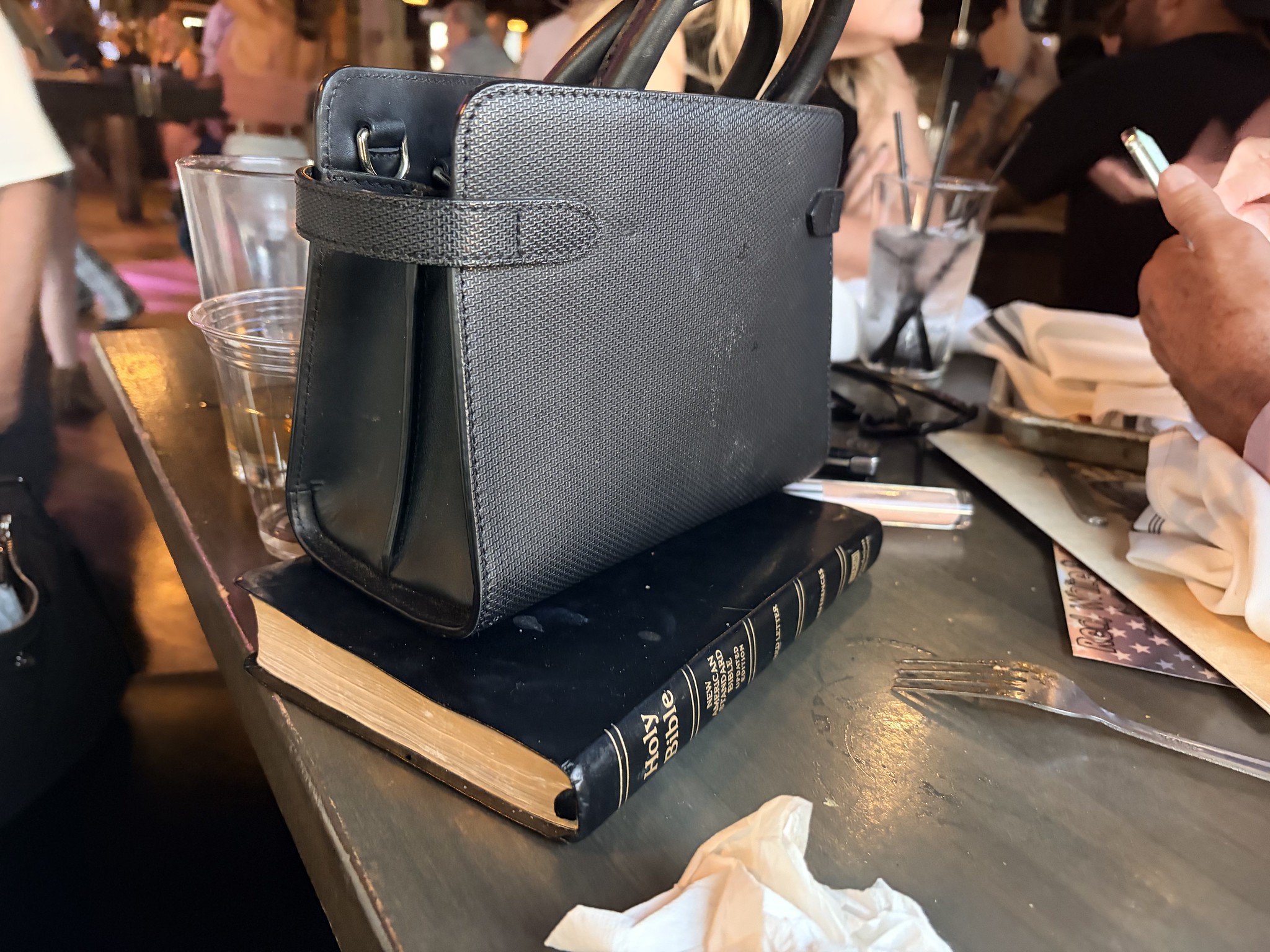
Over the years I relaxed most of that. And one night I found myself reading my Bible in a restaurant.
I’d gone early to a line dance lesson. My girlfriends were running late, so I grabbed a high table near the wall, ordered something, and opened my Bible while I waited. Around me was the usual scene: neon signs, boots on a scuffed wooden floor, a country song playing louder than it needed to, people laughing over drinks.
And somewhere in the middle of a chapter, I looked up and wondered whether anyone in that room would know I was a Christian if I weren’t holding this book.
They’d figure it out the minute I opened my mouth, probably. But just looking at me? My clothes, my boots, the drink on the table, the fact that I was there at all? I wasn’t sure. And that evoked a discomfort within me, because it made me ask whether, in my long effort to be relatable, to meet people where they are, to reach them, I’d swung so far from the girl hiding her collarbones that I’d started toeing the line on the other side.
And what does worldly even mean? The Bible speaks to it, but it speaks inside a culture that isn’t ours. The disciples’ world isn’t mine. Neither is the world of believers in Lagos or Seoul or rural Guatemala, whose churches draw these lines in very different places than my first church did.
That question came up again a few weeks ago over a bottle of wine.
I’d been invited to a celebration at someone’s home, and in conversation I mentioned bringing a bottle of wine to share. A woman there was nearly offended at the suggestion. The alcohol, she explained, was worldly. It wasn’t “that kind of celebration,” she cited as the rationale, hinting it as something Christians would not partake of.
For context, I’m a certified sommelier. To me, a bottle of wine is a gift, something chosen with care for the people who’ve cooked a meal and opened their home. They can share it at the table or keep it for another night. It has been used for Communion. It never occurred to me that it might land as an emblem of worldliness.
She wasn’t being unkind. She was being honest to a conviction she holds sincerely. But the exchange put my bar-table question in sharper focus. If she and I can look at the same bottle and see two opposite things, what’s the standard? Where’s the line?
The Hebrew word for holy has always helped me here.
Qadosh means set apart, but it isn’t only a word about distance. When God tells Israel, “You shall be holy to me, for I the LORD am holy and have separated you from the peoples, that you should be mine” (Leviticus 20:26), the separation has a direction. They’re set apart from the nations, but they’re set apart to Him. Holiness is a matter of belonging before it’s a matter of avoiding.
Jesus prays the same over His disciples on the night before the cross. “They are not of the world, just as I am not of the world. Sanctify them in the truth; your word is truth. As you sent me into the world, so I have sent them into the world” (John 17:16-18). The verb sanctify is hagiazō, to make holy, to set apart. And notice what He sets them apart by: not a dress code, not a list of things to avoid, but the truth of God’s Word. And notice what He does with them once they’re set apart. He sends them into the world. He specifically says, a verse earlier, “I do not ask that you take them out of the world” (17:15).
So the set-apart life isn’t a retreat. It’s a sending, by someone who belongs to Someone.
Paul is surprisingly blunt about the rules I grew up with.
He tells the Colossians that regulations like “Do not handle, Do not taste, Do not touch” have “an appearance of wisdom in promoting self-made religion and asceticism and severity to the body, but they are of no value in stopping the indulgence of the flesh” (Colossians 2:21-23).
That’s sobering to read as someone who spent years obeying exactly that sort of list. All my rules about music and necklines did look like wisdom. They felt like holiness. But they didn’t touch the parts of me that most needed changing. I was quite capable of pride, gossip, and judgment while wearing a turtleneck.
Jesus made the same point when He said nothing outside a person can defile them, “but the things that come out of a person are what defile him” (Mark 7:15). Then He listed what comes out of the heart: evil thoughts, sexual immorality, theft, murder, adultery, coveting, wickedness, deceit, sensuality, envy, slander, pride, foolishness (7:21-22). Not one of those is a garment or a song.
John defines worldliness in a way I’ve come to trust more than any list. “For all that is in the world, the desires of the flesh and the desires of the eyes and pride of life, is not from the Father but is from the world” (1 John 2:16). Worldliness, by that measure, is a set of desires. A posture of the heart. Which means a woman in a high-necked blouse can be thoroughly worldly, and a woman reading her Bible in a bar may or may not be, depending on what she’s actually reaching for.
As for the wine, God’s Word says a few things:
It warns clearly: “Do not get drunk with wine, for that is debauchery” (Ephesians 5:18). Proverbs calls wine a mocker for anyone led astray by it (20:1). Those limits stand.
But it also treats wine as a gift. The psalmist praises God for “wine to gladden the heart of man” (Psalm 104:15). Deuteronomy, of all places, tells Israelites who lived too far from the sanctuary to carry their tithe to exchange it for money, travel to the place of worship, and spend it on “oxen or sheep or wine or strong drink, whatever your appetite craves,” and to “eat there before the LORD your God and rejoice” (Deuteronomy 14:26). And Jesus’s first sign, in John’s Gospel, was turning water into wine at a wedding, and good wine at that (John 2:10).
Jesus pointed out the double bind His own culture had built around this. John the Baptist came neither eating bread nor drinking wine, and people said he had a demon. Then “the Son of Man has come eating and drinking, and you say, ‘Look at him! A glutton and a drunkard, a friend of tax collectors and sinners!'” (Luke 7:33-34). Both men were set apart. One abstained and one didn’t. Both were criticized for it.
Abstaining can be a holy calling, too. The Nazirite vow in Numbers 6 set certain people apart to God by having them give up wine entirely. But it was a vow for some, not a law for all.
Which brings me back to the woman at the celebration, and to Romans 14.
Paul writes to a church split over food and drink and holy days, and he doesn’t settle it by declaring one side right. “Let not the one who eats despise the one who abstains, and let not the one who abstains pass judgment on the one who eats, for God has welcomed him” (14:3). Both are accountable to the Lord. Both are welcomed. Neither gets to sit in judgment over the other.
And then he adds a limit on my side: “It is good not to eat meat or drink wine or do anything that causes your brother to stumble” (14:21).
Ultimately, upon sensing her discomfort, something else was brought instead. My freedom to give wine as a gift doesn’t oblige anyone to receive it as one, and love makes adjustment without a debate.
Daniel is the person I keep looking to for how to live this.
He was carried off to Babylon as a young man and drafted into the king’s service. He was taught “the literature and language of the Chaldeans” (Daniel 1:4). He was given a Babylonian name, one honoring a Babylonian god (1:7). He served in a pagan court his whole life. By any outward measure, he was deeply embedded in that culture.
And yet “Daniel resolved that he would not defile himself with the king’s food, or with the wine that he drank” (1:8). The Hebrew is wonderful there, literally that he set it upon his heart. He drew a line at a specific place, deliberately, and he held it. Not at the language. Not at the name. Not at the job. At the table.
I don’t know precisely why he drew it there (scholars have several theories), but I notice that his set-apartness wasn’t total withdrawal. It was a handful of carefully chosen convictions, held firmly, inside a life fully engaged with the world around him.
Lot is the warning on the other side.
He first “moved his tent as far as Sodom” (Genesis 13:12). By chapter 19 he’s sitting at Sodom’s gate, which is where the city’s leading men sat. It was a gradual drift, tent pole by tent pole. Peter still calls him righteous, a man tormented by what he saw around him (2 Peter 2:7-8). His heart hadn’t gone over entirely.
But when the angels told Lot to warn his family and flee, he went to his future sons-in-law with the news, and “he seemed to his sons-in-law to be jesting” (Genesis 19:14).
That line chills me. Lot had blended in so well that when he finally spoke about God’s judgment, nobody took him seriously. His words carried no weight because his life had become indistinguishable from the city’s.
That’s what I was afraid of at that bar table. Not that I was sinning by being there. That I’d become so relatable that if I ever needed to say something that mattered, it would sound like a joke.
So back to my original question: how would anyone know?
Jesus answered that more simply than any list I was given as a teenager. “By this all people will know that you are my disciples, if you have love for one another” (John 13:35).
Not by my neckline. Not by what’s in my glass. By love. By how I treat the bartender, and the girlfriend who shows up 40 minutes late, and the stranger at the next table who’s had a bad week. By whether I’m the same person on Sunday night that I am on Sunday morning.
I think set-apartness lives mostly in the heart, where John placed it: in what I desire, what I’m reaching for, what I’m proud of. It shows up in a few deliberate lines, chosen the way Daniel chose his and not handed down like the rules I memorized as a teenager. And it shows up, most visibly, in love.
I still read my Bible sometimes while I wait for friends. I still bring wine to dinners when I’m sure it’ll be welcome. But I’ve started asking a different question than the one I used to. Not whether anyone could tell I’m a Christian by looking at me, but whether they could tell by spending an evening with me.
I hope so.