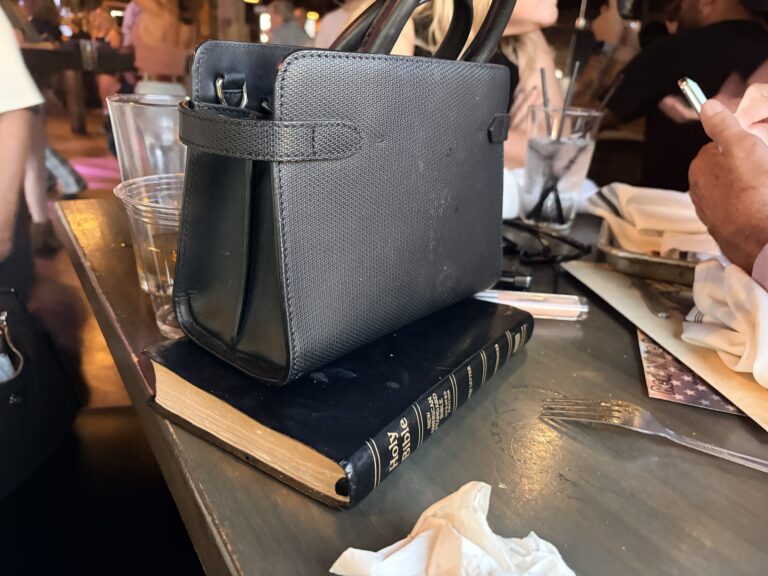
Pressed But Not Cornered
Most of my hard seasons have been made of circumstances. A court date, a job that went sideways, a budget that stopped closing. This one is different. This season is made of people.
I noticed it somewhere last September, when I realized I’d started flinching at my own phone. Not at any one message in particular. At the general possibility of the next one.
- Colin’s father is still doing what he has done for years, only with smaller tools now that the larger ones failed him. He tried to have me removed from my son’s life and lost, so these days it’s the schedule, the exchanges, any lever he can pull that might give him a little control over me, with Colin standing in the middle of it.
- My mother, whom I have no contact with for reasons I won’t recount here, found out where I live. She has since appeared at my door and at my workplace, uninvited and unwanted.
- There are a few men I’ve said no to, clearly and more than once, who haven’t gone away. They don’t press hard. They hover. Some of them might even be reading this blog. They wait at the edges of things, checking every so often to see whether the no has worn thin.
- There are people at work, and a couple I once counted as friends, who seem to have found entertainment in talking about me. Some of it looks like jealousy. Some of it looks like plain boredom.
- There are gamers at some of the nights I run who expect the evening to bend to their preferences, and who let me know about it when it doesn’t. (I have a funny story here, in that the most detailed complaints tend to come from the people who did the least to make the night happen, and who were handed a table, a game, and a host for free.)
- And there are Christian communities I’ve poured into for years that went silent the one time I needed something back.
Any one of these I could handle without much thought. All of them at once have produced a very specific feeling in me, and I’ve finally put words to it. It’s a small, panicked voice that says… what am I going to do?
Paul has a phrase for this season that I’ve been leaning on.
“We are afflicted in every way, but not crushed” (2 Corinthians 4:8). The first verb is thlibō, to press, to squeeze, the word you’d use for grapes in a winepress or a crowd pushing on a body. The second is stenochōreō, which is harder to translate in one word. It means to be confined to a narrow space, hemmed into a room so small you can’t turn around.
So Paul is drawing a distinction I hadn’t noticed before. Pressure from every side is one thing. Being cornered is another.
I think that’s the shape of what I’m being asked to learn. The pressing is going to happen. People are going to lean on me…. some with malice, some with need, some just out of habit. The question is whether I let them impact the room I live in.
The prophet Micah described almost my entire list.
I came across this passage a few weeks ago and had to put the Bible down for a minute. “Put no trust in a neighbor; have no confidence in a friend… for the son treats the father with contempt, the daughter rises up against her mother… a man’s enemies are the men of his own house” (Micah 7:5-6).
Neighbor, friend, household. Micah is writing about a society coming apart at every level of relationship, and he names each level in turn. Jesus later quotes the same verse when He warns His disciples that following Him will set family members against one another (Matthew 10:35-36), which tells me this isn’t a rare or exotic kind of suffering. It’s one Christ expected His people to meet.
But the next verse is the one I keep rereading. “But as for me, I will look to the LORD; I will wait for the God of my salvation; my God will hear me” (Micah 7:7). Micah doesn’t solve the neighbor or the friend or the household. He doesn’t even try. He turns his face.
Psalm 55 helped me with the silence of the churches.
David writes, “For it is not an enemy who taunts me, then I could bear it… But it is you, a man, my equal, my companion, my familiar friend. We used to take sweet counsel together; within God’s house we walked in the throng” (55:12-14). Within God’s house. The people who hurt him most were the ones he’d worshiped beside.
What surprised me more is what David wants to do about it, a few verses earlier. “Oh, that I had wings like a dove! I would fly away and be at rest; yes, I would wander far away; I would lodge in the wilderness” (55:6-7).
I’ve written about my cardboard box in the alley, the place where it’s only me and God and nobody can reach me. David had the same fantasy three thousand years before I did. And I notice he doesn’t get the wings. The psalm ends instead with “Cast your burden on the LORD, and he will sustain you” (55:22). Not flight. Sustaining. He stays in the city with the people who betrayed him, and God holds him up there.
Jeremiah gave me words for the gossip.
“For I hear many whispering. Terror is on every side! ‘Denounce him! Let us denounce him!’ say all my close friends, watching for my fall” (Jeremiah 20:10). The phrase terror on every side, magor missabib in Hebrew, was apparently something of a catchphrase for Jeremiah, and his enemies seem to have turned it into a mocking nickname for him. They were whispering his own words about him.
That’s what gossip does. It takes the pieces of you and passes them around a room you aren’t in. And Jeremiah’s response in the next verse is so short I almost missed it: “But the LORD is with me as a dread warrior” (20:11). He doesn’t track down each whisperer. He reminds himself who is standing beside him.
The men who won’t take no for an answer remind me of a refrain in the Song of Songs.
Three times the woman in that book charges the daughters of Jerusalem, “that you not stir up or awaken love until it pleases” (2:7, 3:5, 8:4). It’s a solemn warning, an oath of sorts, and it’s repeated because it’s important. Love isn’t supposed to be pried open, coaxed, worn down, or waited out. It wakes on its own or it doesn’t wake at all.
A man who hovers after a clear no is trying to awaken something before it pleases. I don’t need to argue with him about it. I just need to stop treating persistence as my problem to manage.
The gamers, I’ll admit, made me laugh once I saw the parallel.
After Jesus fed the five thousand, the crowd chased Him across the lake. He didn’t receive it as devotion. “Truly, truly, I say to you, you are seeking me, not because you saw signs, but because you ate your fill of the loaves” (John 6:26). They wanted the bread again, made the way they liked it.
I’m not comparing my game nights to the feeding of the five thousand (though the nights where a hundred people showed up comes close). I’m only noticing that Jesus was not rattled when people came for what He could provide instead of for Him. He named it, and He kept teaching.
So what is the fear, underneath all of this?
When I sit with the what am I going to do?! feeling, I find an assumption hiding in it.
It assumes that every one of these people is mine to manage. That if my mother shows up, I have to fix it; if a man lingers, I have to find the perfect sentence to end it; if a community goes quiet, I have to earn my way back into their attention. The fear isn’t only that people will hurt me. It’s that I’ll fail to handle them well enough.
Isaiah has a question for that. “I, I am he who comforts you; who are you that you are afraid of man who dies, of the son of man who is made like grass, and have forgotten the LORD, your Maker… and you fear continually all the day because of the wrath of the oppressor?” (Isaiah 51:12-13).
Who are you that you are afraid?
It’s not a scolding question. It’s a reminder of identity. You belong to the One who stretched out the heavens, and you’re spending your days afraid of people who will wilt like grass. The oppressor’s wrath is real. It’s also small.
Jesus had a way with crowds I’d like to learn.
John says that many people believed in Jesus when they saw His signs in Jerusalem, “but Jesus on his part did not entrust himself to them, because he knew all people” (John 2:23-24). The Greek plays on a single verb. They pisteuō, believed, in Him. He did not pisteuō, entrust, Himself to them.
That’s the cleanest picture of a boundary I’ve found in the Bible. Jesus didn’t send them away. He didn’t fear them, either. He received them, healed them, taught them, and simply did not hand them the keys to Himself. He knew what was in people, and knowing it didn’t make Him anxious. It made Him free.
The uncomfortable truth here is that some of my boundaries have been built out of fear.
I’ve put up walls this season because I was frightened, and I can tell, because they’ve been brittle. They go up in a hurry and I spend a lot of energy guarding them. I think boundaries built from security behave differently. They’re calmer. They don’t need to be defended every hour, because the person holding them isn’t afraid of what’s on the other side.
Some caution is wisdom, of course. My mother (or Colin’s dad, for that matter) at my door is a safety concern, not an exercise in courage, and I’ve treated it that way. Not fearing people doesn’t mean becoming naïve about them. It means my response comes from a settled place instead of a panicked one.
There’s a scene in Luke that sat with me. The people of Nazareth, His own hometown, are so enraged by His sermon that they drive Jesus to the edge of a cliff to throw Him off. And the text says, with no further explanation, “But passing through their midst, he went away” (Luke 4:30).
He didn’t fight them. He didn’t plead. He walked through the middle of the crowd that wanted Him dead, and they let Him go.
I don’t know how He did that, and I don’t expect to manage it with that kind of composure anytime soon. But I’d like to learn to walk through the pressing without letting it narrow the room. Afflicted on every side, Paul said, but not hemmed in.
I think that’s the lesson of this season. I’m still learning it.